
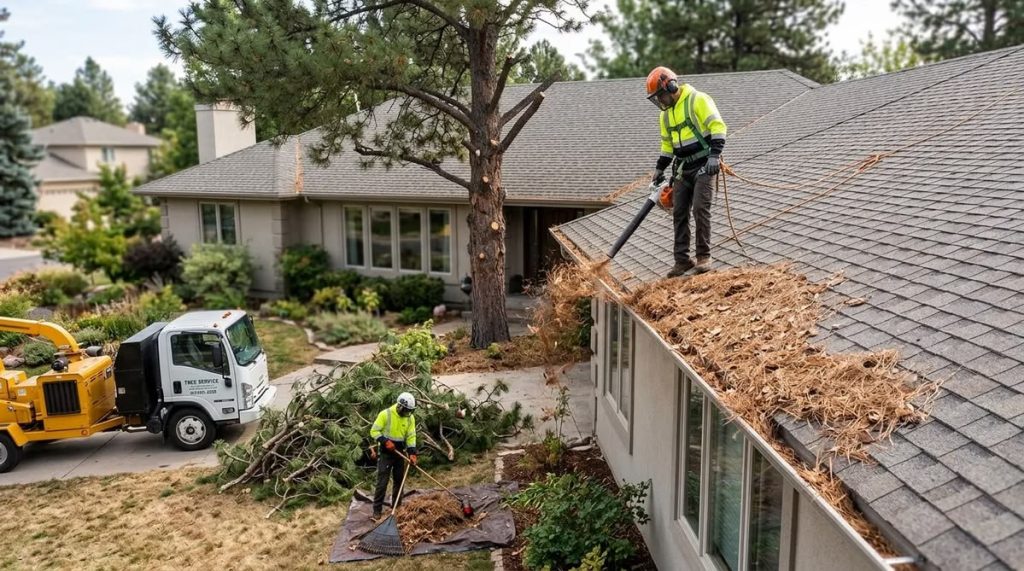
Nobody budgets for bark. Nobody types roofing company santee ca into a search bar in September. Then the first storm sheets water over the lip of a gutter packed solid with eucalyptus litter, and the overflow runs back under the eave instead of down the downspout. For a hillside lot in Santee the point is narrow: gutter cleaning, a roof inspection, and vent and waterproofing checks booked before October turn a predictable annual mess into scheduled maintenance one crew finishes in a single visit.
Debris Season Arrives Weeks Before The Rain
Eucalyptus does not shed politely. Long ribbons of bark come down through late summer, then leaves and hard seed capsules keep dropping into November, and on a sloped lot most of that load slides toward the low corner where the gutter already carries the most water. What usually turns up when a gutter is opened after the first rain is a dense plug of bark fiber holding damp grit, not a light layer of leaves.
A homeowner on a hillside street near Mast Park watched a stain spread across a bedroom ceiling in December and assumed the roof had failed. It had not. One twelve-foot gutter run had, and water had been backing into the eave since the second week of the rains.
A Month By Month Plan For The Wet Window
The wet window in San Diego County runs roughly October through March, so the schedule backs up from there. Clear gutters and downspouts in the last week of September, before the debris is wet enough to compact. Have the roof inspected on the same visit, because a crew already up the ladder can check flashing, vent boots and low-slope transitions without a second mobilization. Bundling matters more than it sounds, since roofing labor is priced by the square rather than by the hour, and figures SquareDash published in January 2026 put installation labor at $150 to $300 per square nationally, with Northeast crews closer to $250 to $400. Each separate trip means paying for that setup again.
Example maintenance timeline for a Santee hillside lot under eucalyptus, illustrative only
| Month | Task Due | Why It Is Timed There |
| Late September | Gutter and downspout clearing | Debris is still dry and lifts out before it compacts |
| October | Roof inspection, flashing and vent check | Rides along with the clearing, ahead of the first storm |
| November | Waterproofing and skylight seal check | Early rain exposes weak seals while repairs are small |
| December | Mid-season look at the shaded runs | Eucalyptus keeps dropping after the first storms pass |
| January to February | Post-storm walk of the low corner | Wind-driven litter reblocks the busiest run first |
| March | Season close-out, notes and photos filed | Damage found now can be scheduled in dry weather |
None of it is complicated, and none of it needs guessing. What makes the schedule hold is writing it down, because the task that gets skipped is always the one nobody assigned a month to. Booking gets harder as the season goes, too: the same roofing company Santee CA homeowners call after a ceiling stain appears is fielding emergency work all winter, and a September appointment is far easier to get than a January one. Lots that drain toward the house deserve a mid-season look in late December.
Ask for the inspection notes in writing, and keep them. A dated record of what was cleared, what was photographed and what was flagged for the following year is the difference between guessing and knowing when a shingle finally lifts. It also shortens any warranty conversation, since manufacturer coverage and a workmanship warranty both turn on whether the roof was maintained. Mine lives in one folder with the invoices and the crew photos, sorted by year.
Ask These Questions Before Booking The Crew
Start with the ladder, because that is where people get hurt. Clearing gutters from a ladder causes serious falls every year, and anything above a single story, or anything on a wet slope, belongs to a crew with proper equipment. OSHA’s construction fall protection rules require protection any time a worker is exposed to a fall of 6 feet or more to a lower level, and falls remain the leading cause of death in construction. If the roof is wet, stay off it. A licensed crew carries harnesses, anchors and insurance for exactly this situation.
- Does the price cover flushing the downspouts, or only clearing the gutter troughs? A good answer covers both and says how the crew confirms the run actually drains.
- Will the same visit include a roof inspection with photos I can keep? A good answer promises dated photos plus a written list of what was flagged.
- How do you handle the second story and the sloped side of the lot? A good answer names the fall protection they use rather than promising to be careful.
- Who pays if a tile cracks under a boot while your crew is up there? A good answer points to their liability coverage and their workmanship warranty.
The debris arrives every year on roughly the same schedule, which is the whole opportunity. Work booked in September is quick and boring; the same work in January is an emergency with a ceiling stain attached. Put the cleaning, the inspection and the vent and waterproofing checks on one date before the rains, give the list to one company, and file what comes back.