Karen and Dale closed on a 1990s split level in eastern Jackson County and inherited the tankless water heater in the utility closet. Nobody at the walkthrough mentioned that the thing has a maintenance schedule. Six years later the shower drops to lukewarm the second the dishwasher fills, the panel blinks the same code every few days, and they searched water heater repair independence mo to price a service call against a full replacement. The unit was not dying. It was packed with scale, a smaller problem with a much smaller invoice, and on inherited equipment it is the mistake we see most often.
Lukewarm Mid Shower Water Is A Scale Symptom
A tankless heater stores nothing, so its entire job is a rate: so many gallons a minute, raised so many degrees. Think of a short order kitchen with one cook, where the shower and the dishwasher are two tickets landing in the same second. Scale is what shrinks that cook’s output. Deposit builds inside the heat exchanger, heat transfer falls off, and the unit either cuts flow to hold your temperature or lets temperature slide to hold flow.
One symptom does not belong on that list. Soot around the vent, a burning smell, or a carbon monoxide alarm sounding is not a diagnosis you work through in the utility closet: OSHA’s carbon monoxide fact sheet directs anyone exposed to move to fresh air immediately and call 911. Everyone goes outside first, then you call the gas utility from the yard. Hot water can wait.
Hard Water Here Shortens The Flush Interval
Manufacturers publish a descaling interval, and a March 2026 maintenance rundown from Design Transition Studio puts the usual guidance at every 12 to 24 months, with hard water areas needing service more often to hold efficiency and prevent scale damage. Anyone who has scrubbed a glass shower door in eastern Jackson County knows which end of that range applies. Twenty four months is for somewhere else. Annual is the working number, and on a unit that has gone six years untouched the first flush takes longer and costs more than the ones after it.
Clearing An Error Code Instead Of Reading It
The code is the most useful thing a tankless unit does, and homeowners throw it away fastest. Power cycling the unit clears the display, hot water comes back for a day or two, and the actual fault goes unrecorded. Then it repeats. A code thrown at the same point in the same cycle is a log entry, not a glitch. A unit that trips only under high demand is telling a different story than one that trips cold on the first call for heat, and the plumber who hears both details on the phone brings the right parts. Write down the code, the day, and what was running in the house at the time. Three data points beat a week of resets.
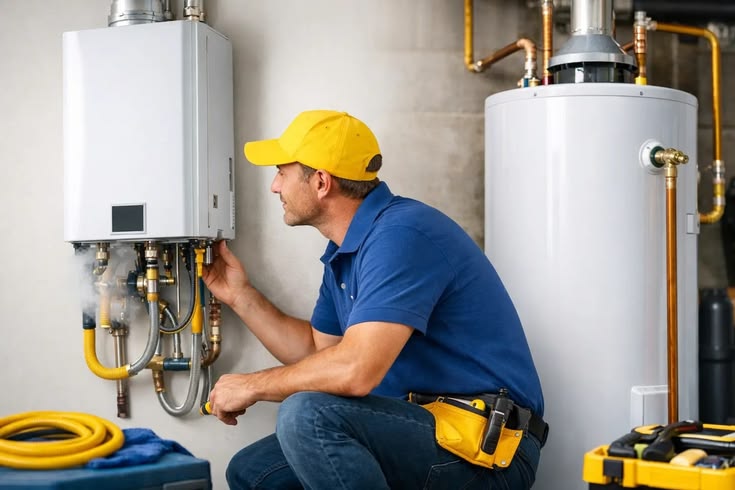
The visit itself is unglamorous. What gets searched as water heater repair independence mo more often ends in a descaling kit and an hour of pump time than in a new appliance sitting in the driveway. A tech reads the code history, checks inlet and outlet temperature under load, pulls the filter screen, and circulates descaler through the exchanger. The answer usually turns up in that hour.
A Venting Or Combustion Warning Ends The DIY
The line between a scale problem and a combustion problem is not subtle. Scale codes track flow and temperature. Ignition failures, flame loss, and blocked exhaust codes track fire and air, and nobody should be clearing those. If a unit locks out twice on the same ignition or venting fault, stop, shut off the gas at the appliance valve, and call a licensed plumber; a repeating fault in that family is where the do it yourself part ends.
Questions That Separate Tankless Plumbers From Generalists
Plenty of good plumbers do not touch tankless equipment weekly, and the difference shows in the first two minutes of a call. Ask before the truck rolls, and listen for whether the answers carry numbers or adjectives. Four questions sort it out.
- How many tankless units did your crew descale last month? A specific number, not a category, is the answer you want.
- Do you read the unit’s code history before you quote, or after? Reading it first is the only order that saves a second trip.
- Are the descaling kit and the pump time itemized separately from the diagnostic fee? A good answer names both figures on the phone.
- What would make you recommend replacement instead of repair on a six year old unit? A straight answer names the heat exchanger and parts availability, not the age.
None of these are trick questions. A shop that services tankless units weekly answers all four without pausing, and quotes the descaling separately from the diagnostic. A shop that hedges on all four is quoting you a replacement in advance.
Descaling Is Maintenance Not A Replacement Sentence
A tankless unit that runs lukewarm under load and blinks a code every few days is not automatically at the end of anything. Six years without a flush is a maintenance debt, and clearing it costs closer to a service call than to a new appliance plus a day of installation labor. Get the code written down, get the exchanger flushed, and put the next flush on the calendar before the truck leaves the driveway. Empty nesters who bought the house, not the heater, usually get the same news: the equipment was fine, the six years were not.