
A building owner walked into the shop last spring carrying a two-foot length of decorative edge metal wrapped in a shop towel. It had come off the parapet of her family’s 1920s brick storefront on a Central Texas courthouse square, it was pitted clean through in two spots, and three suppliers had already told her that nothing shaped like it gets made anymore. Calls like hers reach a metal roofing company Waco TX building owners hire for historic work more often than the ordinary replacement business does. The short version of the answer is this: a discontinued profile is a fabrication problem rather than a purchasing problem, and it gets solved on a brake and a roll former instead of on somebody’s stock list. She left with a template and a date.
Old Metal Profiles Rarely Exist as Stock Panels
Metal roofing on a pre-war commercial building was a local product. A tinner in town ran his own brake, and the seam spacing on any given storefront usually reflected what that shop’s tooling could do rather than a published standard. Panel widths landed where they landed. The supply chain now runs the other direction, with mills producing a short menu of profiles in volume: sixteen and eighteen inch panels, one inch or one and three quarter inch seams, a rib pattern somebody chose in a product meeting. Those are good panels, and on new construction they are exactly right. They are simply not the panel that came off a 1920s storefront, and no amount of ordering will turn one into the other.
Close Enough Substitutions Show From the Sidewalk
Anyone who has ever repaired a printed document knows this problem in a different costume. Reset one paragraph of a restored page in a typeface that is nearly the original, and no reader can name what is wrong, yet every reader senses that something is. The counters sit a hair too round, the spacing is off by a whisker, and the page stops reading as one document. Roof metal behaves the same way. Move seam spacing two inches across sixty linear feet and the shadow lines fall in different places, so the facade reads as repaired rather than restored. In practice we see that complaint arrive weeks after the job closes out, once the owner has walked across the square at four in the afternoon and finally caught it in raking light.
Templating an Old Seam Is Measured, Not Guessed
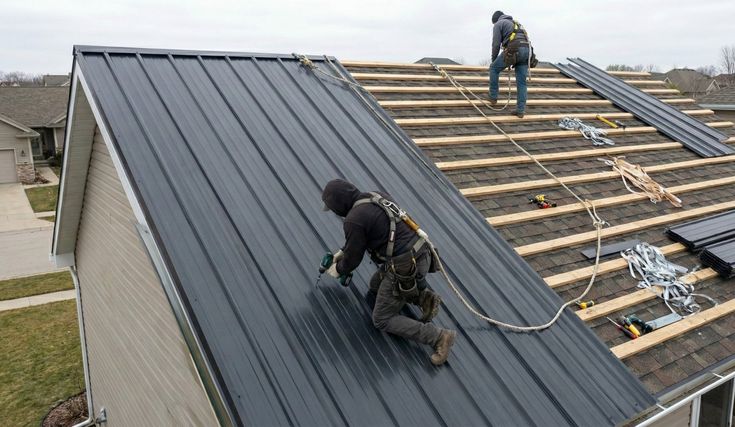
Templating starts with the piece in hand, never with a photograph. A crew pulls a sample of the original trim, traces its bends onto card stock, and checks the angle of every break with a protractor before a single sheet gets cut. No building owner should climb up to take those measurements personally. An aging low-slope metal roof hides corroded fasteners and soft decking, and this work belongs to insured crews using fall protection. Federal investigators recently proposed $172,324 in penalties against a roofing employer that allowed work above 20 feet without personal fall protection, after two workers slipped off a two-story house while tarping storm damage and one of them was killed. A template is cheap. A fall is not.
A Nearby Roll Former Beats a Distant Queue
Lead time is the part owners underestimate, and it is the first question worth putting to any metal roofing company Waco TX owners are considering for a restoration run. A custom order pushed through a distributor sits in somebody else’s queue, and a seam set two degrees wrong, discovered on the roof, sends the whole cycle back to the start. A shop with its own roll former can pull a test panel, drive it to the building, hold it against the surviving run and adjust that same afternoon. Cost pressure has made that tight loop matter more than it used to, since MarketingCode’s roofing industry news reported installed metal roofing at $9 to $16 per square foot in July 2026, roughly 60 percent higher than mid-2025 after Section 232 tariffs on imported steel and aluminum doubled from 25 to 50 percent. Rework at those numbers stops being a rounding error.
Run the arithmetic on that storefront and the shape of the job gets clear. Roughly 60 linear feet of standing seam plus about 90 feet of decorative edge trim, with fabrication billed at, say, $95 an hour. Templating and setup take 6 hours, forming the panels takes 9, and the trim, which carries four breaks and a hemmed edge, takes 14 (yes, the small stuff outlasts the roof every time). That is 29 shop hours, or $2,755 in labor before any metal is bought. Add 140 pounds of coated coil at $4.20 a pound and the fabrication side comes to $3,343 all in, which is a number an owner can weigh against a facade she has to look at every day.
Questions Owners Ask Before a Fabrication Run
How Long Does a Custom Fabrication Run Take?
Shop time is the smaller half of the schedule. Templating and approval usually run longer than the forming does, because the sample panel has to go back to the building and get looked at in daylight beside the original. On a storefront this size, plan on two to three weeks from template to delivered metal, and longer if a coating color has to be ordered special.
Will a Fabricated Panel Match the Original Finish?
Not exactly, and anybody promising otherwise is guessing. Eighty years of Texas sun does things to a finish that no coating line reproduces on demand. What a shop can do is match the profile and get the sheen close enough that the new work reads as part of the building, then let it weather in.
Is Custom Metal Worth It on a Small Storefront?
That depends on what the facade is worth to the person who owns it. A stock panel costs less on the invoice and more on the sidewalk, where the building sits in front of customers all day long. Most owners settle the question themselves once a sample panel is held up next to the surviving original.
Profile Matching Is a Shop Capability, Not Luck
That length of edge metal went back up in September, with sixty feet of seam and ninety feet of trim behind it. Nobody on the square said a word about it, which is the entire point of restoration work done right. So the useful question for an owner with a discontinued profile is not which stock panel comes closest, but whether the contractor owns the tooling to reproduce the correct one from a template. Ask where the brake is, and who runs it. That answer sorts the field fast.