Rubber molding equipment has to control two different but connected tasks: injecting the compound into the mold and holding the mold closed while the material cures. As rubber components become more complex and production volumes rise, manufacturers need stable clamping, repeatable injection, and efficient machine operation. These requirements are shaping the development of hydraulic clamping systems and servo-driven hydraulic technology.
The industry is placing greater emphasis on more efficient hydraulic power management. Rather than maintaining a constant hydraulic output throughout the entire cycle, newer machines can vary pump performance according to the demands of each molding stage. This makes the combination of hydraulic clamping and servo-driven hydraulic control increasingly relevant to current rubber manufacturing.
Why Clamping Stability Matters in Rubber Molding
Clamping force has a direct relationship with mold closure. During injection, the rubber compound creates pressure inside the cavity. The clamping system needs to keep the mold closed and maintain the required force throughout injection and curing.
A hydraulic clamping injection molding machine uses hydraulic power to generate and maintain this force. Hydraulic systems are widely used in industrial molding because they can provide substantial force while allowing controlled mold movement.
For rubber applications, clamping stability is particularly important because mold opening can lead to flash, dimensional variation, or other quality problems. The required force depends on factors such as projected mold area, injection pressure, cavity design, and rubber compound.
The goal is therefore not simply to increase clamping force. The machine needs to provide an appropriate force range and maintain it consistently during the relevant stages of the cycle.
Servo Hydraulics Are Changing Machine Operation
Conventional hydraulic machines can require the pump to operate at a relatively high level even when the molding cycle does not need continuous maximum hydraulic output. Servo-driven hydraulic systems offer another approach.
A servo hydraulic injection molding machine combines a servo motor with the hydraulic system. The motor speed can respond to the machine’s actual operating requirements, allowing hydraulic output to change during different stages of the molding cycle.
During mold movement or injection, the system can provide the required hydraulic power. During periods of lower demand, the servo motor can reduce its operating level. This can improve energy utilization and reduce unnecessary hydraulic activity.
The benefits depend on the machine configuration and production cycle. Servo hydraulics do not automatically make every molding application more efficient. Their value becomes clearer when the control system can match hydraulic output with actual machine demand.
Production Trends Are Increasing the Need for Process Control
Rubber products are used across automotive, electrical, construction, agricultural, and industrial applications. These parts can vary widely in size, material, mold structure, and production volume.
A sealing component may require precise mold closure and repeatable injection. A larger industrial rubber component may place greater demands on clamping capacity and mold handling. These differences mean that machine control needs to correspond with the specific application.
Automation is also becoming more common. Mold opening and closing, injection, curing, demolding, and other operations can be coordinated through the machine control system.
The combination of stable clamping and controlled hydraulic output can help manufacturers maintain a more predictable molding cycle. It also gives equipment designers more opportunities to adjust machine behavior according to the requirements of different applications.
Dekuma’s RV-Se Series
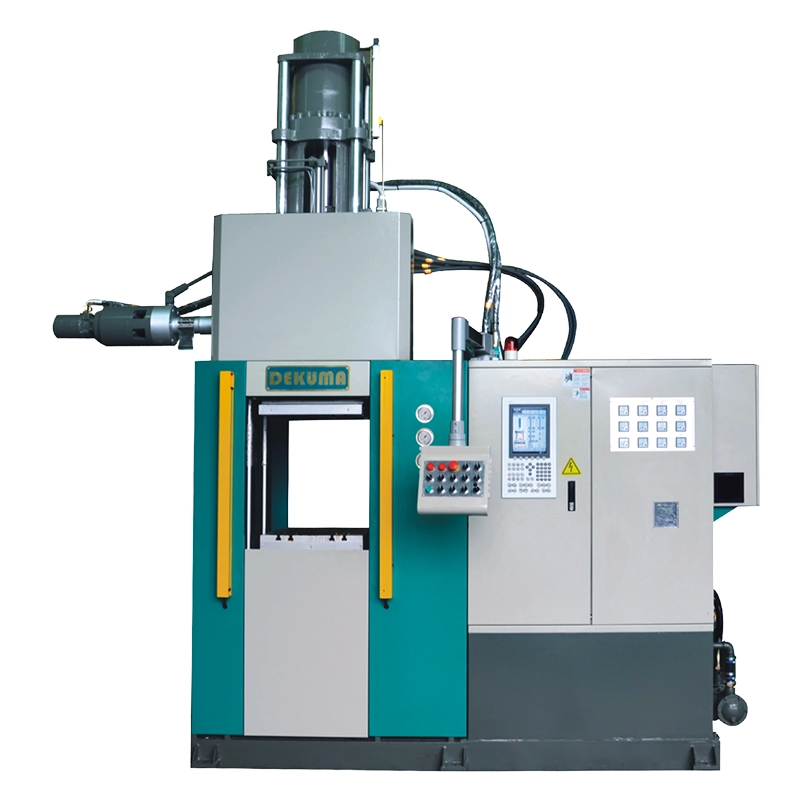
Dekuma offers the RV-Se Series rubber injection molding machine with a servo-driven hydraulic system. The machine is designed for rubber applications involving materials such as natural rubber and EPDM.
The RV-Se Series uses servo hydraulic technology to control the injection and machine movement according to production requirements. Its configuration is intended to support stable injection and clamping while providing more responsive hydraulic power management.
The machine can also be configured around different mold and product requirements. This is relevant to manufacturers that handle multiple rubber components rather than a single standardized product.
Its positioning is practical rather than application-specific to one particular rubber part. The machine platform can serve production requirements where injection control, hydraulic clamping, and energy management are important considerations.
What Manufacturers Need to Consider
When evaluating a hydraulic clamping injection molding machine, manufacturers need to look beyond nominal clamping force. Injection capacity, mold dimensions, pressure requirements, hydraulic control, cycle time, and automation all affect whether a machine fits the intended application.
Servo hydraulic technology can provide another consideration. A servo hydraulic injection molding machine can adjust hydraulic output according to the machine cycle, which may be useful in applications where hydraulic demand varies significantly between operations.
The selection still depends on the complete production process. Machine configuration, rubber compound, mold design, product dimensions, and expected output need to be considered together.
For manufacturers seeking equipment with controlled hydraulic power and stable clamping, Dekuma‘s RV-Se Series provides an option built around servo-driven hydraulic technology. Its approach reflects a wider industry shift toward more controlled and application-focused rubber molding equipment.