Production efficiency in panel furniture manufacturing is shaped by much more than drilling speed. Hole spacing, workpiece handling, repeated positioning, batch consistency, and the number of operations performed on each panel can all affect how smoothly a workshop moves from raw boards to assembled components.
By cutting down on unnecessary handling and coordinating repeated drilling tasks, a boring machine for wood can make this process more efficient. HUAHUA CNC provides equipment examples that show how multi-head machining can be applied to practical furniture production.
Reduce Repeated Panel Handling
Every additional repositioning step creates another opportunity for alignment differences, operator intervention, and production delays. When several holes can be processed without moving the panel between separate drilling stages, the workflow becomes easier to organize and monitor.
This advantage becomes particularly relevant for cabinet components containing multiple hole patterns. Kitchen and bathroom furniture often requires repeated drilling across different sections of a panel, so moving each workpiece between separate operations can consume considerable time across a large batch.
A CNC boring machine can coordinate programmed drilling movements within a defined machining sequence, reducing the need for repeated manual positioning. The actual efficiency gain depends on the panel design, hole pattern, tooling configuration, and production volume rather than machine speed alone.
Increase Multi-Point Processing Capacity
Production capacity can also improve when several suitable drilling operations take place simultaneously. Parallel processing makes better use of the available machining time, particularly when panels contain separated hole groups that would otherwise be handled in successive cycles.
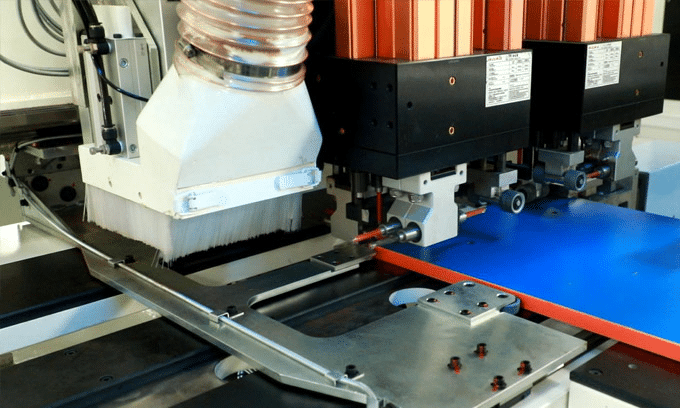
The SKH-612NS illustrates this approach with two high-precision drilling heads. When the distance between two holes exceeds 85 mm, the two heads can process them simultaneously. HUAHUA CNC states that this configuration can provide 20% higher production capacity than a single-drilling-head machine, with the equipment suited to bathroom cabinet and kitchen cabinet production.
Such an arrangement changes how cycle time should be evaluated. Instead of asking only how quickly one drilling head completes an individual hole, production planners can examine how many relevant operations are processed during the same machine cycle. A boring machine for wood can provide greater practical efficiency when its multi-head configuration corresponds closely with the hole patterns used in daily production.
Improve Workflow Consistency
Efficiency is closely related to predictability. A production line becomes easier to schedule when similar panels can pass through a repeatable machining sequence without frequent manual adjustments or transfers between workstations.
Furniture components often contain standardized hole arrangements because connectors, hinges, shelf supports, and other fittings need to align with corresponding parts. Using consistent drilling programs across production batches helps maintain the specified hole positions for connectors, hinges, and shelf supports. This makes it easier to reproduce cabinet components according to the same machining requirements.
The effect is particularly useful in batch production, where the same panel specification may be processed many times. A CNC boring machine can store or execute defined drilling instructions according to its control configuration, allowing operators to focus more closely on material preparation, quality checks, and workflow supervision.
Match Equipment With Furniture Applications
Not every production environment benefits equally from multi-head machining. The value depends on the geometry of the workpiece and the frequency with which particular drilling patterns appear. Panels with widely separated hole groups can make better use of simultaneous processing than components containing only a small number of closely spaced holes.
Product variety should also be considered. Bathroom cabinets and kitchen cabinets may contain recurring drilling layouts, making them suitable for production methods that prioritize repeatability. Custom furniture with highly variable designs may require a different balance between automated processing and operator flexibility.
Material characteristics can influence productivity as well. Board thickness, density, surface finish, and drilling requirements affect tool selection and machining parameters. Equipment should be assessed against the actual panel materials and component designs rather than assuming that the same efficiency pattern applies to every woodworking application.
Consider Efficiency Beyond Cycle Time
Cycle time provides useful information, but it does not represent the entire production process. Loading, unloading, inspection, panel transfers, setup changes, tool replacement, and occasional rework can all contribute to the actual time required to produce usable components.
A more practical evaluation tracks the complete path of a panel through the drilling operation. If two machines have similar drilling speeds but one requires substantially more repositioning or manual handling, their real production efficiency may differ considerably.
Maintenance also affects long-term productivity. Tool wear, drilling-head condition, dust accumulation, positioning accuracy, and routine servicing can influence whether the equipment continues to operate consistently. HUAHUA CNC’s woodworking machinery demonstrates how equipment configuration can be considered alongside these broader workflow factors instead of treating drilling speed as the sole measure of efficiency.
Conclusion
Production efficiency in woodworking comes from how effectively machine capacity, panel movement, drilling patterns, and operator activity fit together. Multi-head processing can shorten certain machining cycles, while reduced repositioning can limit unnecessary handling and improve workflow continuity. The most useful assessment comes from comparing these effects with the actual panel designs and production volumes of a workshop.
For kitchen and bathroom cabinet production, the SKH-612NS illustrates how multi-head drilling can be matched with recurring hole patterns and batch-processing requirements. Its practical contribution should be evaluated through actual cycle times, material handling, and the proportion of drilling operations that can be completed simultaneously.
A boring machine for wood can contribute to higher productivity when its processing arrangement matches the workpiece geometry and production rhythm. HUAHUA CNC provides one example of this approach, while each workshop still needs to assess handling time, cycle requirements, tooling, maintenance, and product variety before determining how much efficiency a particular CNC boring machine can add to its manufacturing process.