
The transition toward decentralized renewable energy is fundamentally reshaping how modern businesses manage their operational overhead. As utility grids face unprecedented strain and peak demand tariffs continue to climb, corporate facilities can no longer rely exclusively on traditional electricity providers. While capturing solar power during daylight hours is a vital first step, the true financial leverage lies in intelligent power retention.
By integrating robust commercial solar energy storage networks, businesses can store surplus daytime generation and strategically deploy it during expensive evening hours. This load-shifting capability slashes daily utility costs and provides critical backup power to keep essential machinery running during unexpected grid outages. However, as these commercial battery deployments scale from small indoor racks to massive outdoor megawatt systems, engineers face a critical physical hurdle: managing the immense heat generated by densely packed lithium cells.
Choosing the correct thermal management architecture—between established air cooling and advanced liquid cooling—is the most consequential decision in the procurement process. It directly dictates the system’s upfront cost, maintenance schedule, and total operational lifespan.
The Thermal Management Challenge
Lithium-based chemistry is sensitive to temperature fluctuations. During aggressive charge and discharge cycles—such as those required for commercial peak-shaving operations—the cells generate significant internal heat.
If this thermal load is not actively managed, the battery rack will experience uneven temperature gradients. These localized “hot spots” accelerate chemical degradation, lowering the battery’s round-trip efficiency and permanently reducing its overall storage capacity. To protect a multi-million-dollar energy investment and ensure the hardware lasts its intended 10-to-15-year lifecycle, facilities must deploy dedicated cooling infrastructure to keep the internal chemistry within its optimal thermal window.
The Foundation of Mechanical Simplicity: Air Cooling
For a vast majority of standard commercial deployments, intelligent air cooling remains a robust, financially attractive, and proven architectural choice. These systems utilize variable-speed fans and optimized internal ducting to pull conditioned ambient air directly across the sensitive battery racks.
By eliminating complex internal plumbing, coolant pumps, and liquid manifolds, air-cooled systems lower upfront capital expenditures. Furthermore, ongoing maintenance is predictable. Field technicians primarily need to perform routine air filter replacements and standard fan inspections, minimizing long-term operational complexity.
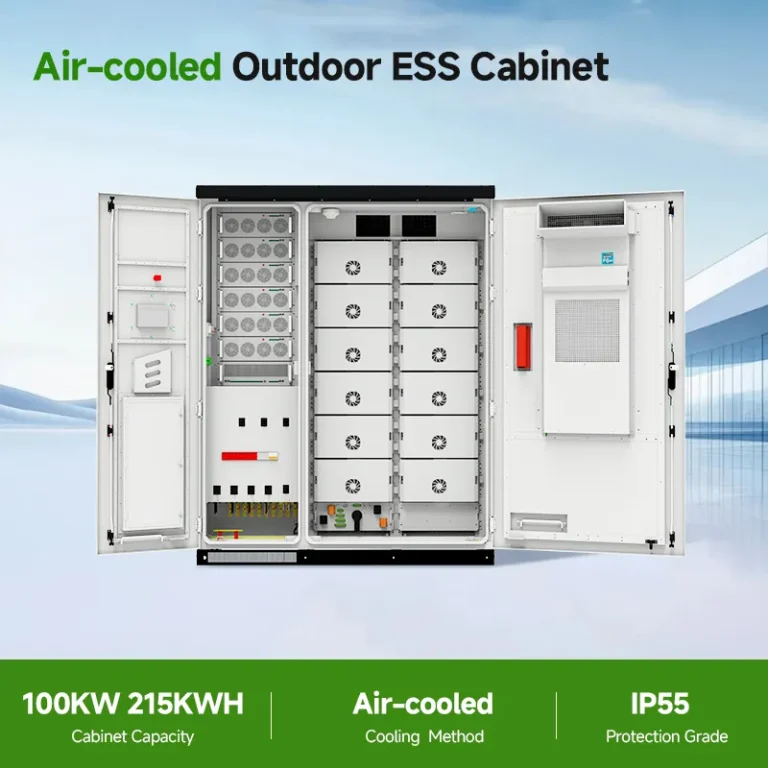
A premier example of this established technology is the Sunway Air Cooling 100kW 215kWh Outdoor Cabinet. This heavy-duty, integrated system delivers a massive 215kWh of Lithium Iron Phosphate (LFP) storage alongside a 100kW rated AC power output. Housed within a rugged IP54-rated enclosure, it serves as a deeply reliable outdoor solar battery storage solution that protects internal components from harsh weather and airborne dust while delivering consistent, high-capacity power to the facility.
Precision Control and High Density: Liquid Cooling
While air cooling excels in straightforward deployment scenarios, high-throughput industrial operations and facilities with strict spatial constraints increasingly require superior thermal precision. Because ambient air possesses a relatively low specific heat capacity, it can struggle to efficiently remove heat from ultra-dense battery configurations during aggressive, continuous cycling.
Liquid cooling solves this physical limitation. These advanced systems utilize a closed-loop network of specialized coolant pumped directly through cold plates situated against the battery modules. Liquid absorbs and transports heat with incredible efficiency, virtually eliminating localized hot spots. This precise, direct-contact thermal regulation slows cell degradation, maximizing the system’s long-term financial return.
For heavy industrial applications requiring maximum energy density, the Sunway Intelligent Liquid-Cooled 100kW 232kWh Outdoor Cabinet represents the cutting edge of modern engineering. This system packs 232kWh of premium LFP storage into an exceptionally compact footprint. Because the closed-loop liquid system does not require a constant intake of outside air for cooling, the cabinet is tightly sealed with an IP55 protection rating. This isolates the sensitive internal electronics from corrosive coastal salt spray, fine metallic dust, and heavy moisture.
Making the Right Engineering Decision
Selecting between air-cooled and liquid-cooled architecture requires a detailed analysis of your specific commercial site:
- Choose Air-Cooled (e.g., the 215kWh Cabinet) if: Your facility prioritizes a lower initial capital expenditure, has ample outdoor real estate for slightly larger cabinet footprints, operates in a moderate climate, and values straightforward, mechanical maintenance protocols.
- Choose Liquid-Cooled (e.g., the 232kWh Cabinet) if: Your operation faces severe spatial constraints, operates in intensely polluted or coastal environments requiring sealed IP55 protection, or requires the highest energy density to manage severe, high-throughput daily cycling without rapid degradation.
Partnering for Commercial Resilience
Navigating the complexities of large-scale thermal management demands a comprehensive engineering strategy. The success of a commercial transition toward independent renewable energy hinges on the durability and operational efficiency of the chosen hardware.
By teaming up with an experienced global manufacturer like Sunway Solar, businesses gain access to fully certified, factory-tested turnkey solutions across both air-cooled and liquid-cooled architectures. Evaluating your exact environmental constraints and power demands with industry experts ensures that your enterprise deploys the precise infrastructure required to conquer rising utility costs and build a genuinely resilient electrical network for the future.