Scroll through any social feed and you will find them: screenshots of quiz results, checklists with boxes ticked, and captions that read “I got a 54, what did you get?” Viral internet tests have become a small but powerful form of online writing. They are short, personal, and built to be shared.
For anyone who writes for the web, these tests are worth studying. They show how a few carefully chosen words and a simple numeric result can turn a private activity into a public conversation. This article looks at the language behind viral internet tests, why the “score out of 100” format works so well, and what writers and content creators can borrow from it.
Why Short Quizzes Spread So Easily
A good viral quiz asks very little of the reader. There is no account to create, no long text to read, and no special knowledge required. The reader simply answers honestly and receives a result.
Three features explain most of the appeal:
- Low effort. Each question can be answered in a second or two.
- Personal relevance. The reader is the subject, so every question feels like it was written for them.
- A built-in reason to share. A result is only interesting when compared with someone else’s.
These qualities mirror advice that grammar and writing guides give all the time: keep it short, keep it clear, and write for a specific reader. Quizzes simply apply the principle in its purest form.
The Grammar Behind the Questions
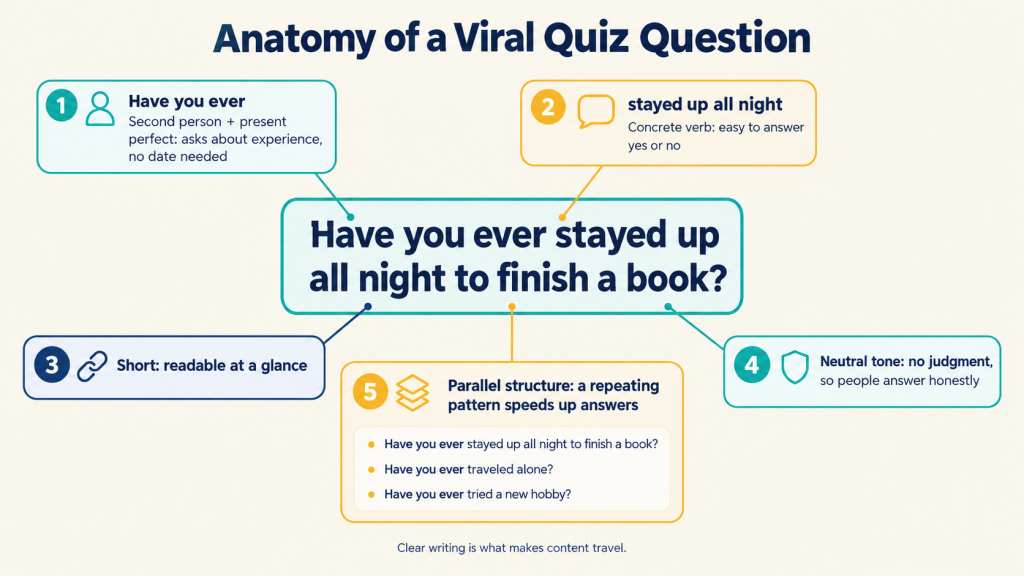
Look closely at how quiz items are phrased and a pattern appears. Most are written in the second person and the present perfect tense: “Have you ever…?” This construction is useful because it asks about experience at any point in life without needing a specific date. The reader does not have to remember when something happened, only whether it did.
Other language choices make quizzes easy to process:
- Short sentences. Items rarely run past a single line, so they can be read at a glance.
- Concrete verbs. Statements describe actions, not abstract ideas, which makes them easy to answer yes or no.
- Parallel structure. When every item follows the same pattern, the reader quickly learns the rhythm and moves faster.
- Neutral tone. Good quizzes avoid judgment in the wording, which keeps readers comfortable answering honestly.
Parallel structure deserves special attention. Writers are often taught to keep list items grammatically consistent, and quizzes show why. When each line begins the same way, the brain stops decoding the sentence and starts simply responding to it.
Why a Score Out of 100 Feels So Satisfying
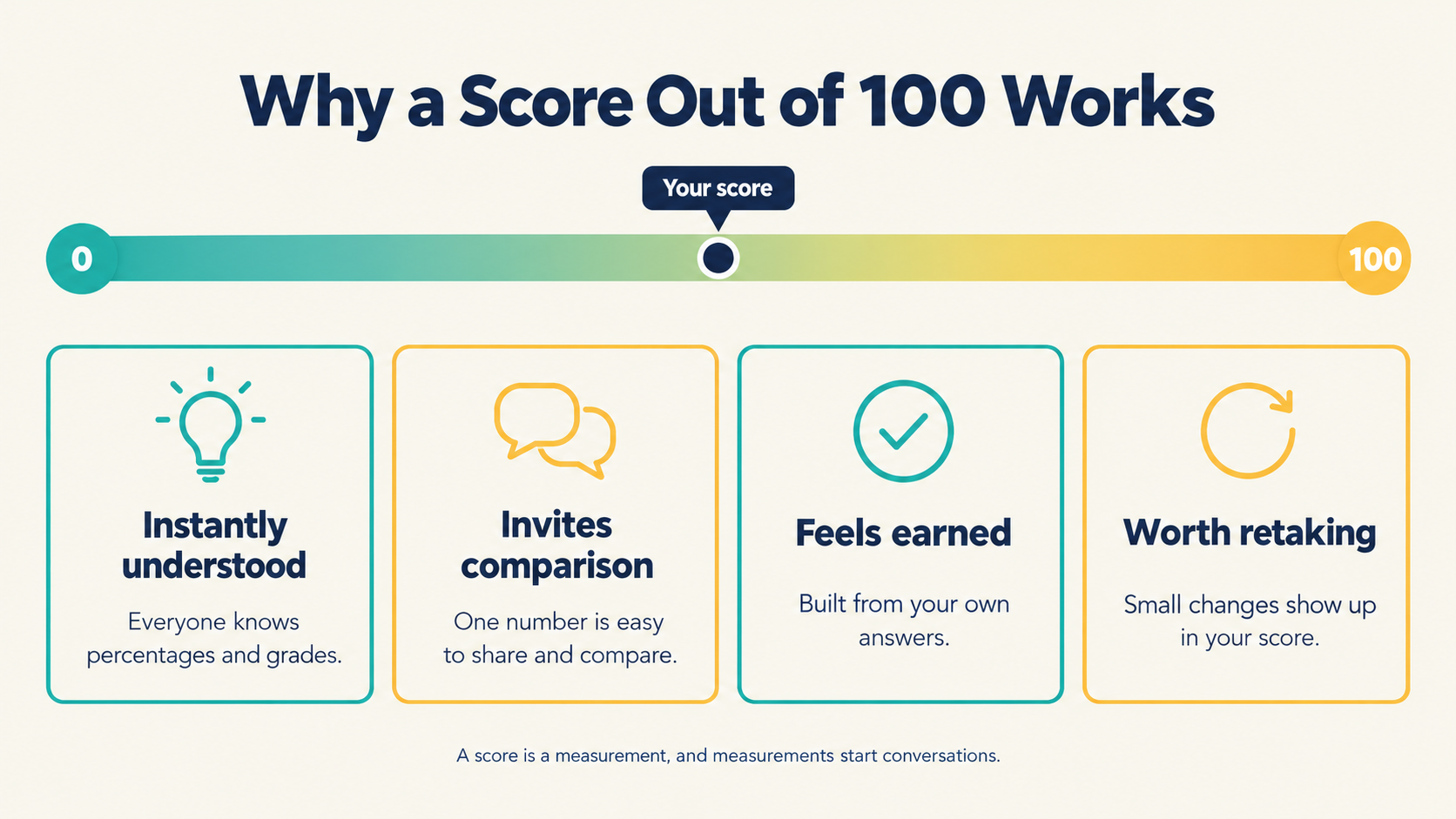
A numeric score does something a written summary cannot: it compresses an entire set of answers into a single, comparable figure. A score out of 100 is especially effective for a few reasons.
It is instantly understood. Everyone grew up with percentages and grades, so no explanation is needed. A reader knows immediately whether 85 is high or 40 is low.
It invites comparison. A number is easy to post, easy to compare, and easy to joke about. Two friends can settle a debate with a single figure.
It feels earned. Because the score is built from the reader’s own answers, the result feels like a personal data point rather than a random label.
It allows repeat participation. Because the scale is wide, small differences matter. People retake tests later in life to see how their number changes.
This is also why score-based tests tend to outlast personality-style quizzes that sort people into a handful of types. A type is a label. A score is a measurement, and measurements invite follow-up conversations.
Case Study: The Rice Purity Test
One of the best-known examples of this format is the Rice Purity Test, a self-reported checklist of 100 items that has circulated among students for decades. It is commonly described as having begun at Rice University, which is where its name comes from, and it has since become a familiar rite of passage in college culture and on social media.
From a language standpoint, it is a textbook example of everything described above. The items are short, written in the second person, and structured in parallel. The scoring system is simple: each item the participant has experienced is checked off, and the final number out of 100 summarizes the results. The format needs no explanation, which is a large part of why it has lasted so long and spread so widely.
It also illustrates how a format can outlive its original context. The test began as a lighthearted student tradition, yet its structure is so portable that it now appears online in countless versions. The underlying mechanics, a checklist, a count, and a score, are what people recognize and share.
How the Format Spreads to Niche Communities
Once a format proves itself, communities adapt it to their own interests. The same checklist-and-score structure can be reshaped around a hobby, a fandom, or a shared piece of internet culture, with new questions written in the community’s own vocabulary.
Fandom spaces are a good example. Readers and writers of online fiction have their own shorthand, their own conventions, and their own sense of humor, so it is natural that they would want a version written in their own language. AO3 purity test is one example of this kind of adaptation, where the familiar score-out-of-100 structure is combined with references that a specific community recognizes.
This kind of adaptation highlights something important about language online. People do not just consume formats; they remix them. The shared structure gives everyone a common starting point, and the specialized vocabulary makes the result feel like it belongs to a particular group.
What Writers and Content Creators Can Learn
You do not need to build a quiz to benefit from the lessons behind them. The same principles apply to articles, newsletters, social posts, and product copy.
- Lead with the reader. Second-person phrasing makes content feel personal.
- Keep sentences tight. If a line can be read at a glance, more people will finish it.
- Use parallel structure. Consistent patterns reduce effort and improve rhythm.
- Offer a clear takeaway. A single number, a short list, or a simple rule is easier to remember than a long explanation.
- Make it shareable. Ask whether your reader would want to compare, discuss, or pass along what they just read.
- Write for a community. Specific vocabulary signals that the content is meant for a particular audience.
These habits are not tricks. They are the same fundamentals of clear writing, applied with a focus on how people actually behave online.
Conclusion
Viral internet tests may look like simple entertainment, but they are carefully shaped by language. Short sentences, second-person phrasing, parallel structure, and a score out of 100 combine to create something that is quick to complete, easy to understand, and natural to share.
For writers, the takeaway is straightforward. Clear, concise, reader-focused language is not only good grammar; it is also what makes content travel. The next time you see a friend’s quiz result in your feed, take a moment to look at how the questions were written. There is a lot to learn from them.