
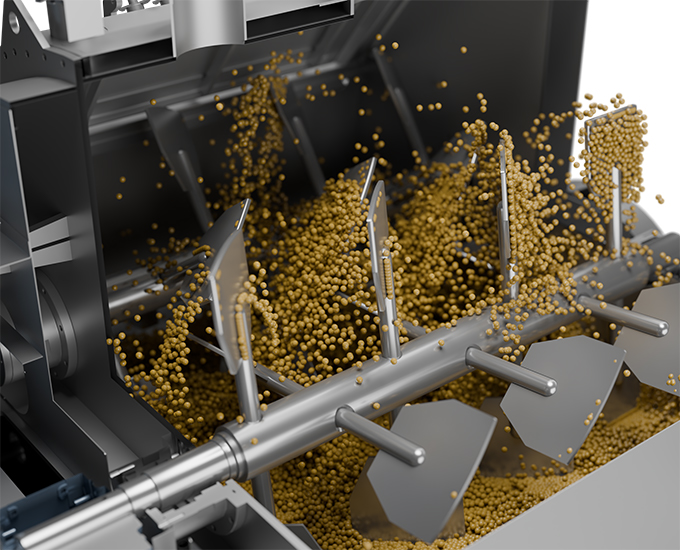
Consistent kibble rarely comes from one isolated setting. Recipe composition, moisture addition, steam conditions, mechanical energy, residence time, and downstream drying can all influence the final product. A pet food manufacturing equipment strategy needs process controls that connect these variables rather than treating each machine independently. FAMSUN’s coating solutions cover livestock, poultry, aquafeed, and pet food applications, illustrating how equipment configuration can be matched with different material and production requirements.
Recipe Control Sets The Starting Point
Recipe management begins with accurate ingredient proportions. Protein sources, starches, fats, fibers, minerals, and functional additives respond differently to heat and moisture, so even a small formulation change can alter extrusion behavior.
Modern control systems can store processing recipes and associate target values with specific products. Operators can then work from defined parameters for screw speed, moisture addition, steam input, and other variables instead of relying entirely on manual adjustment.
Batch records also provide useful historical information. If one production run shows unusual bulk density or expansion, recorded process conditions can help determine whether the change came from the formulation, raw materials, or operating parameters.
How Extruder Speed Influences Kibble
Extruder speed affects how quickly material moves through the processing zone and how much mechanical energy is introduced. Changes in speed can influence residence time, pressure, temperature development, and product expansion.
Higher mechanical input may alter starch transformation and melt behavior, while excessive throughput can shorten the available processing time. Slower operation may increase residence time but can also change production efficiency and thermal exposure.
Recipe-specific speed settings are more practical than using one fixed value for every product. Different formulas may require different combinations of throughput, screw configuration, moisture, and thermal conditions to produce comparable physical characteristics.
Steam And Water Need Coordinated Control
Steam contributes both heat and moisture during conditioning or extrusion preparation. Its effect depends on steam quality, injection rate, distribution, material temperature, and the amount of moisture already present in the formulation.
Water addition has a similar influence but behaves differently within the process. Too little moisture can increase friction and mechanical load, whereas excessive moisture may reduce expansion or change the texture and density of the finished kibble.
PLC-based control can connect these variables with stored recipes. Rather than adjusting steam and water independently, the system can associate target values with a particular formulation and production condition. Such coordination reduces unnecessary variation between batches.
Physical Characteristics Reveal Process Changes
Kibble consistency should be assessed through measurable characteristics rather than appearance alone. Bulk density, moisture, diameter, length, hardness, expansion ratio, and piece durability can provide useful evidence of process stability. Tracking these metrics over time allows operators to detect subtle drifts before they escalate into off‑spec production, making physical testing a predictive tool rather than a simple pass‑fail check.
Density is particularly sensitive to extrusion conditions. A shift in moisture or mechanical energy may change the internal structure of the kibble, even if the external shape appears unchanged.
Sampling should also cover different points within a production run. Early, middle, and late samples can reveal gradual changes caused by raw-material flow, thermal conditions, or equipment adjustments. Trends across multiple batches offer more useful information than one isolated measurement.
Connecting Control With Downstream Processing
Extrusion settings do not exist separately from drying and coating. Moisture remaining in the kibble affects dryer load, while the final surface condition influences the absorption and distribution of added fats or liquid ingredients. Thus, control parameters such as barrel temperature and screw speed should be set not only for expansion but also with an eye on their downstream impact, creating a coordinated line rather than isolated unit operations.
FAMSUN offers several coating configurations, including vertical normal-pressure, vertical vacuum, horizontal normal-pressure, horizontal vacuum, and continuous coating systems. Equipment selection depends on product characteristics, throughput, and the intended coating process rather than relying on one universal configuration. Operators should also evaluate how easily each coating system can be cleaned and reconfigured for different oil or additive applications, since frequent product changes may favour modular designs over fixed setups.
Stable upstream conditions make downstream operations easier to manage. If kibble density or moisture changes substantially from batch to batch, drying and coating behavior may change as well, creating additional adjustments later in the line. Implementing real‑time moisture or density feedback at the extruder exit can alert operators to drift before it affects coating uniformity, reducing the need for corrective actions downstream.
Conclusion
Product consistency depends on coordinated control rather than a single machine setting. Pet food production becomes more predictable when recipe management links extruder speed, steam, water, and other operating variables with measurable quality indicators. PLC-based systems provide a structured way to store process targets and compare actual production data against established recipes. FAMSUN’s extrusion and coating technologies can support different processing requirements, while disciplined parameter management remains central to consistent pet food manufacturing equipment performance across repeated production runs.