In an age of instant text messages, high-definition video calls, and artificial intelligence, it’s easy to forget that the entire digital revolution has a single, humble ancestor. Before the internet, before the telephone, even before the radio was widely used for voice, there was a simple yet revolutionary idea: using patterns of long and short signals to represent letters. This was the birth of Morse code translator.
Invented in the 1830s and 1840s by Samuel F.B. Morse and Alfred Vail for use with the electric telegraph, Morse code was the world’s first digital language. While no longer a commercial necessity, its alphabet of dots and dashes remains a fascinating subject, a practical skill for emergency situations, and a cherished hobby for amateur radio operators worldwide.
This is your guide to understanding the “ABCs” of this historic code.
The Building Blocks: Dots, Dashes, and Pauses
The entire Morse code for alphabet is built from just two sounds or symbols:
The Dot (Di-dah): A short, quick signal. Think of it as the basic unit of time.
The Dash (Dah): A signal that is three times as long as a dot.
The magic happens when you combine these two elements to form letters. The spacing between these signals is just as important as the signals themselves. A standard set of timing rules keeps the code decipherable:
A dash is equal to the length of three dots.
The space between parts of the same letter (e.g., between the two dots in the letter “S”) is equal to the length of one dot.
The space between two different letters in the same word is equal to the length of three dots.
The space between two separate words is equal to the length of seven dots.
This precise timing is what transforms a string of beeps into coherent language.
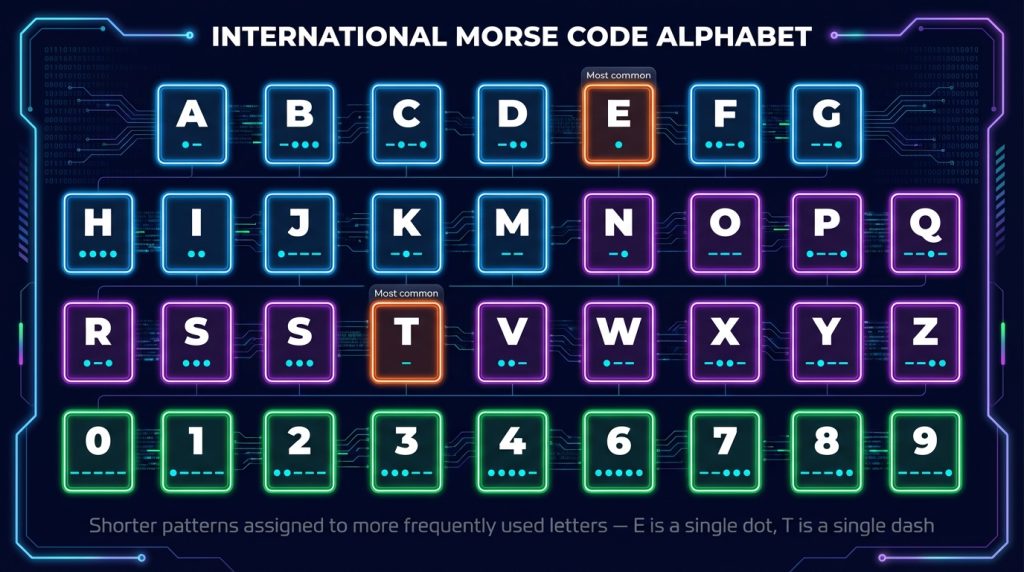
The Morse Code Alphabet: A to Z
The genius of Morse and Vail’s design is that they assigned the shortest, simplest codes to the most frequently used letters in the English language. This was done to speed up transmission and reduce the work for the human operators.
Here is the alphabet, with the code written as dots (•) and dashes (—).
Letter Morse Code Phrase to Remember
A • — A-pple (dot-dash)
B — • • • B-oot camp (dash-dot-dot-dot)
C — • — • C-oca-C-ola (dash-dot-dash-dot)
D — • • D-og house (dash-dot-dot)
E • E-h? (Just a dot)
F • • — • F-ire truck (dot-dot-dash-dot)
G — — • G-ood grief (dash-dash-dot)
H • • • • H-appy day (dot-dot-dot-dot)
I • • I-daho (dot-dot)
J • — — — J-ump for joy (dot-dash-dash-dash)
K — • — K-angaroo (dash-dot-dash)
L • — • • L-ightning bug (dot-dash-dot-dot)
M — — M-ain street (dash-dash)
N — • N-avy (dash-dot)
O — — — O-h my! (dash-dash-dash)
P • — — • P-aint the fence (dot-dash-dash-dot)
Q — — • — Q-ueen’s crown (dash-dash-dot-dash)
R • — • R-abbit run (dot-dash-dot)
S • • • S-tay safe (dot-dot-dot)
T — T-all (Just a dash)
U • • — U-nicycle (dot-dot-dash)
V • • • — V-ictory sign (dot-dot-dot-dash)
W • — — W-hite whale (dot-dash-dash)
X — • • — X-ray vision (dash-dot-dot-dash)
Y — • — — Y-ellow hammer (dash-dot-dash-dash)
Z — — • • Z-ebra crossing (dash-dash-dot-dot)
Tip for Learning: Look at the “Phrase to Remember” column. By saying the phrase out loud, you can feel the natural rhythm of the code. For example, the stressed syllables often represent dashes, while unstressed syllables are dots.
Beyond Letters: Numbers and Prosig**ns
To be truly functional, the code was expanded to include numbers and special punctuation.
Numbers are all five characters long, making them easy to distinguish from letters.
1: • — — — —
2: • • — — —
3: • • • — —
4: • • • • —
5: • • • • •
6: — • • • •
7: — — • • •
8: — — — • •
9: — — — — •
0: — — — — —
Prosigns are special procedural signals, often written with a line above them (e.g., <SOS>), indicating that the letters are sent together as one continuous code without the normal letter spacing. The most famous prosign in the world is the distress signal:
Why Learn Morse Code Today?
You might be wondering, “Why should I learn a 19th-century communication system in the 21st century?” There are several compelling reasons:
Emergency Communication: In a disaster situation where cell towers are down and the power grid is out, a simple transmitter can send a Morse code signal over vast distances with very little power. Knowing the code could literally be a lifesaver.
Amateur Radio (Ham Radio): To this day, the ability to use Morse code (often called “CW” for Continuous Wave) opens up a unique and highly respected mode of communication on the ham radio bands. It cuts through noise and allows for global communication with simple equipment.
Mental Exercise: Learning Morse code is like learning a new language and a form of meditation. It trains your brain to recognize patterns and improves concentration.
Historical Connection: It’s a direct link to a pivotal moment in history. Understanding Morse code for alphabet allows you to appreciate the awe and wonder people felt when, for the first time, a message could travel faster than a horse.
From the first “What hath God wrought?” to the desperate SOS of the Titanic, the language of dots and dashes has shaped our world. The Morse code alphabet is more than just a historical relic; it’s a testament to human ingenuity and a timeless, elegant system for communication when all else fails.